
Around the world, the cities that recovered strongest after a crisis did so by investing early in the people who would rebuild them – starting in classrooms. Through school curricula, early exposure to advanced technology created the skilled workforce that later powered entire tech-led recoveries. In the United States, some of the most successful post-industrial cities – places like Pittsburgh, Indianapolis, Raleigh, or Austin – didn’t simply “bounce back” after the decline of manufacturing. They reinvented themselves by investing early in STEM education, nurturing local talent, and treating young people not as passengers of a shrinking economy but as the architects of a new one. That reinvention rarely started in obvious “innovation centers.” It began in mid-sized cities that embraced the idea that future prosperity belongs to places that equip their youth with 21st-century skills.
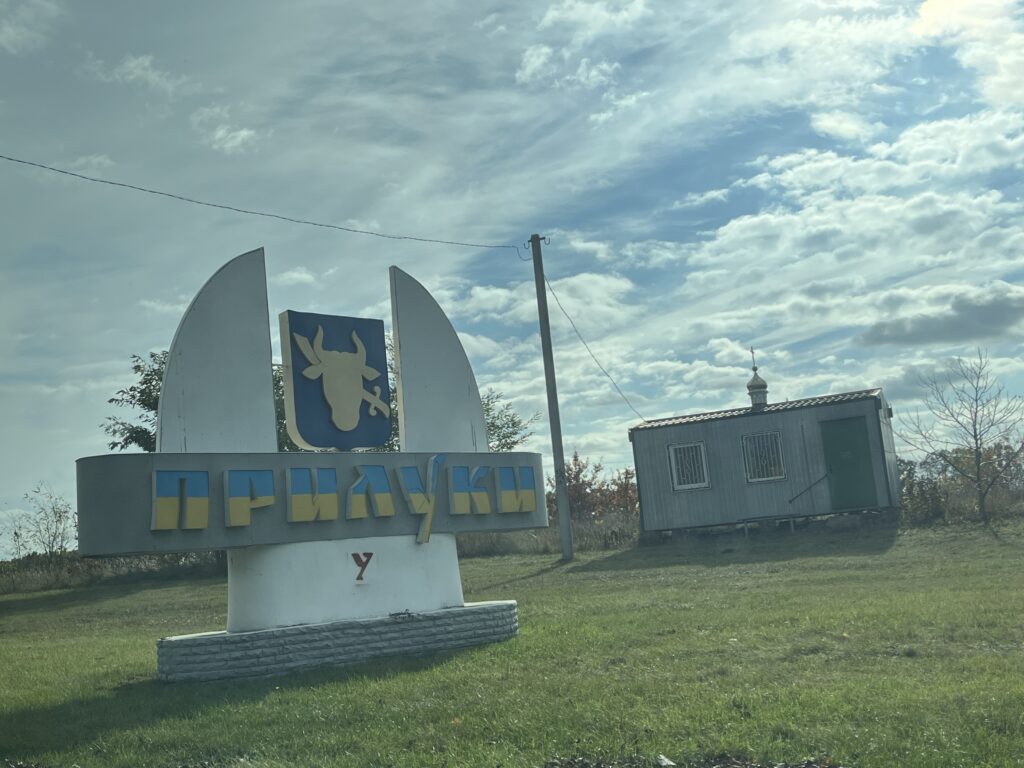
In frontline-adjacent Ukraine today, we are watching something similar take root, and Razom’s STEM investments are helping accelerate that transformation. And we find one of the most inspiring examples in Pryluky, a midsize city in Chernihiv Oblast that saw Russian forces come within ten kilometers in 2022 and still manages daily blackouts. It’s not the first place you’d expect to see cutting-edge robotics education – but stepping inside Pryluky’s Lyceum #1 makes the bright future of Ukraine feel closer than ever. Razom has worked with NGO “The Generation of Success” and its founder Viktoriia Volvich to procure and supply robotics kits to the Lyceum and set up its STEM curriculum.
A Classroom Where the Future Is Being Built
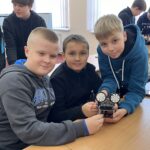
The first thing you notice during one of the regular STEM class periods is a group of boys, huddled in pairs around robot dogs – small, bright creatures made of plastic. Each duo’s face is scrunched up in concentration as they race to beat their classmates and be the first ones to complete the small robot. Thirteen-year-old Zakhar assembled it in just two 30-minute class periods. “It’s a robot dog,” he explains, carefully placing it on the table. “It can spin around and jump like a little projectile.”
When asked how he managed to assemble it so quickly in only his second robotics lesson, he answers simply: “My teacher explained how to do it, and the instructions helped.” He shrugs while responding, a gesture aimed at making it seem like it isn’t a big deal – yet the speed with which the kids grasped the intricacies of motors, sensors, and microcontrollers is nothing short of astonishing. Soon, their next robotics project will up the ante by including coding lessons that will allow the students to program a more complex robot to perform various actions.
But what’s striking about Zakhar is not just his competence, but his clarity about the future he wants to help build. “I think Ukraine will be strong,” he says. “A big, unbreakable country that will win.” He says this while holding the robot he built himself – a small but meaningful sign of what confidence looks like when paired with opportunity.
The teacher Zakhar speaks about is the STEM instructor Oleksii Ivanovych. Before Razom funded robotics kits, he had shown great creativity by teaching robotics concepts using cardboard, scrap wood, and improvised materials. He always believed his students deserved real tools that matched their curiosity. Now that the kits are here, he sees their impact immediately: “We’re finally keeping up with the modern world,” he says. “This equipment teaches kids to think critically, work in teams, discuss problems, and solve them.”
Instead of abstract theory, students now rotate through:
multi-level robotics sets
microcontrollers
motion and temperature sensors
3D printing and laser engraving modules
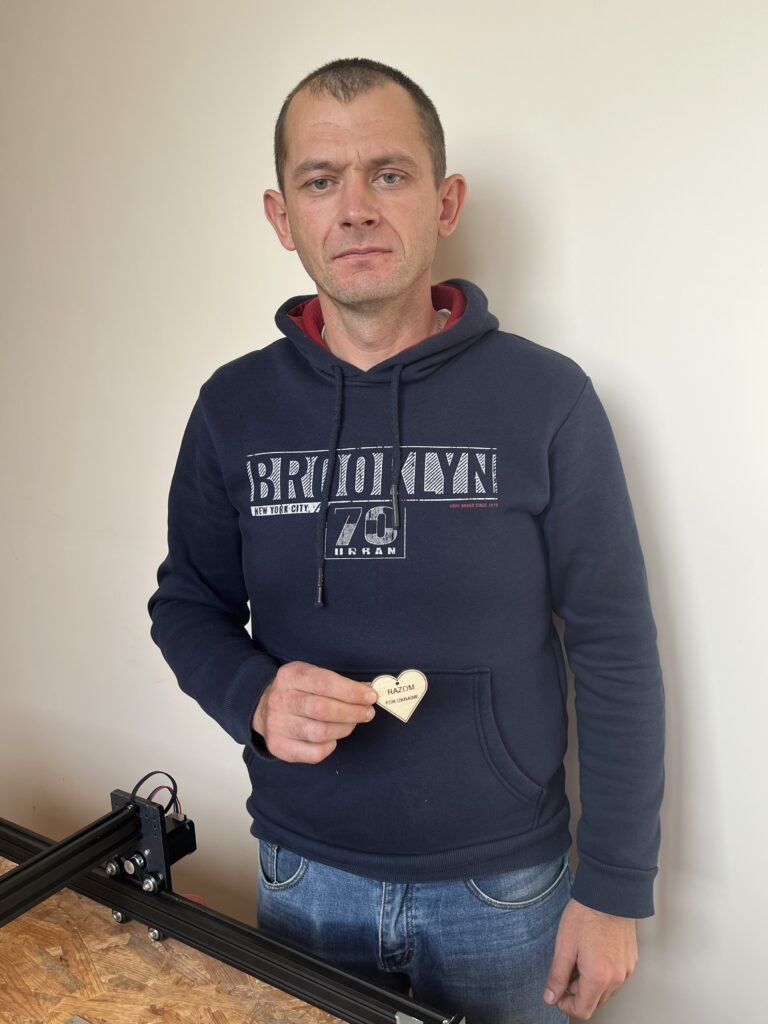
When asked how the students respond, he smiles. “They love it. They want to come to this class. They’re excited to work and to learn.” He emphasizes that robotics should not just be an elective – it’s foundational. “Robotics is everywhere now,” he says. “Medicine, logistics, industry – almost no field works without it anymore.” For a teacher who once taught mechanical movement using syringes and paper, having proper tools is transformative – for him and for his students. To show his gratitude, Oleksii Ivanovych surprises us with a gift – a laser engraved Razom logo, created using the equipment purchased through the grant program.
While Oleksii Ivanovych pours his heart into his students during each class, it is the Lyceum’s Principal Olena Rohaliova who works tirelessly behind the scenes to ensure the school has the best resources possible. So when the NGO “The Generation of Success” leader Viktoriia brought Razom’s grant opportunity to her, the decision was immediate. “This has been my dream for a long time,” she admits. “I wanted modern STEM education, but without equipment, there was no way to make it real.”
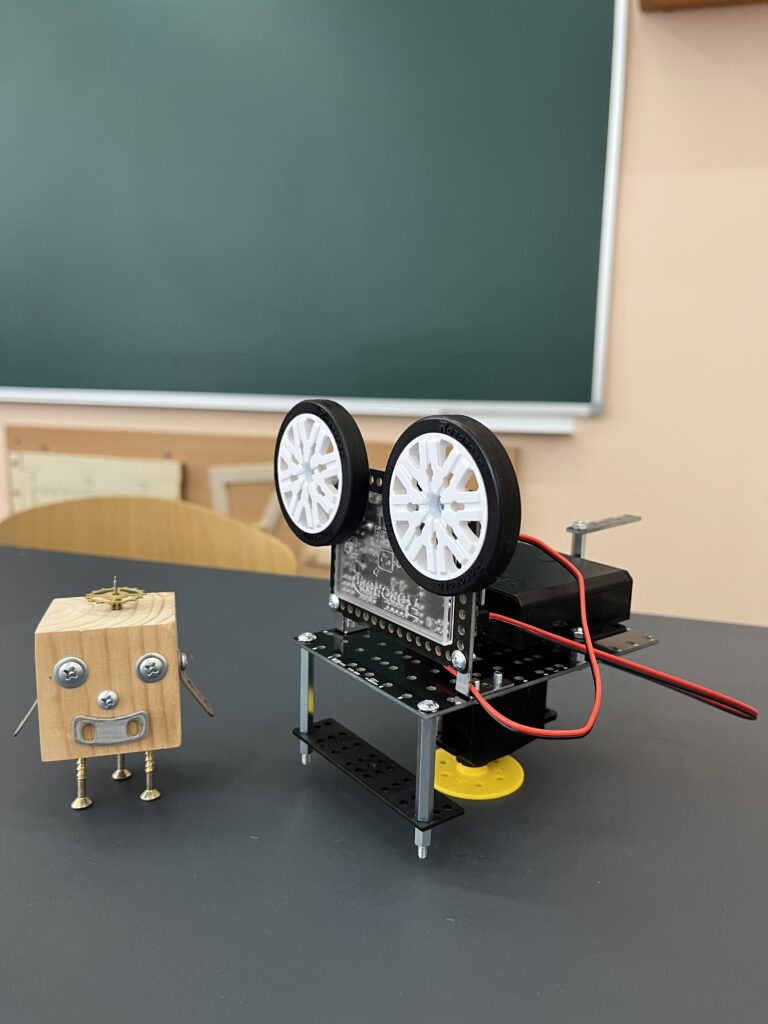
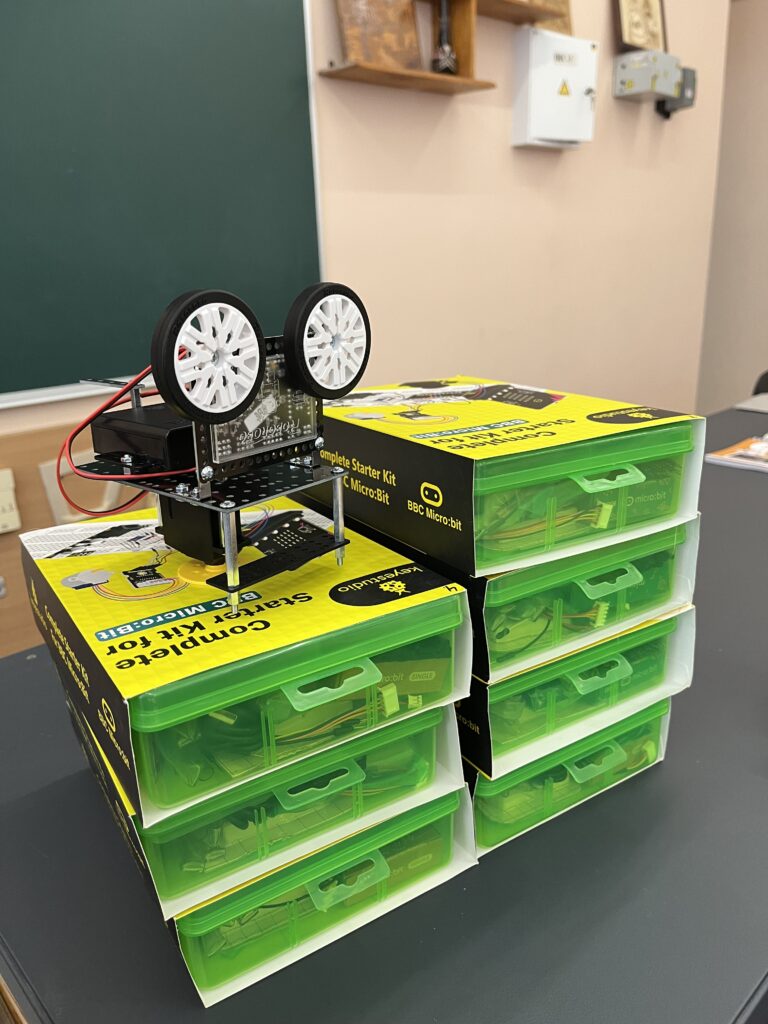
The moment the grant was approved, she convened an emergency meeting of the school’s pedagogical council and rewrote the school’s educational program to officially introduce robotics as a full course – something no other school in the city had done. “Ukrainian schools often don’t prepare students for real life. We have to give them knowledge that feels meaningful — something interesting enough to pull them away from their phones and into thinking, problem-solving, creating.” For Principal Rohaliova, Razom’s support wasn’t just a material investment – it was a catalyst. “Every dollar you invested is working at 200%,” she says. “You helped make our dream real – not just mine, but our teachers’, our students’, and their parents’.”
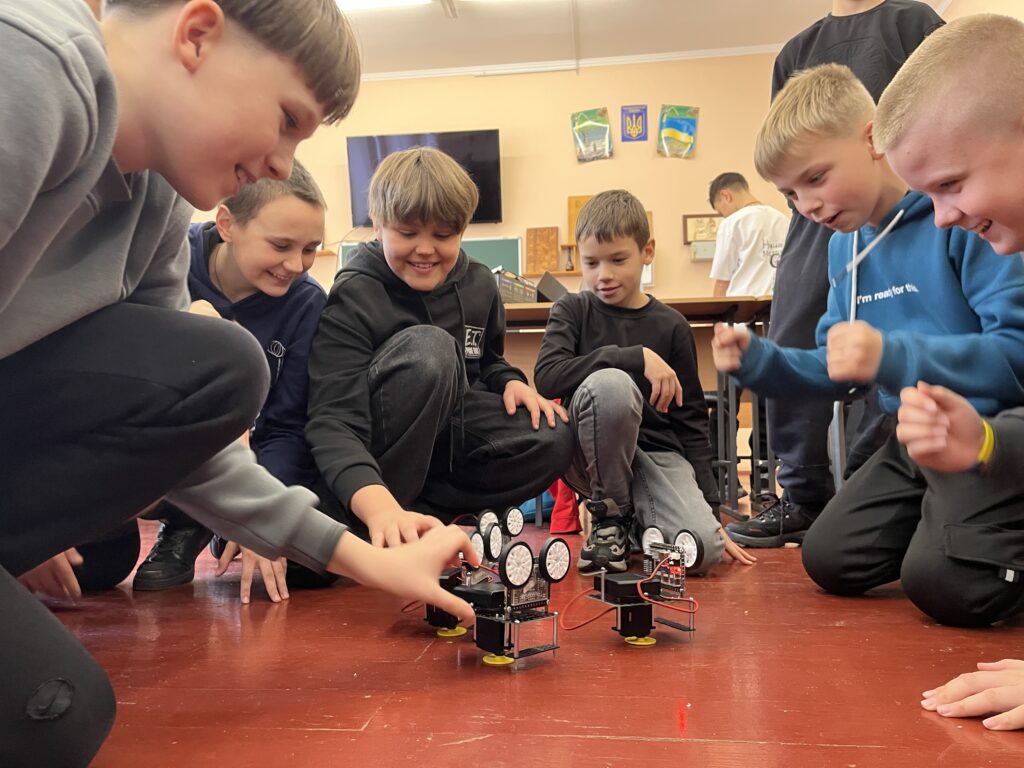
And parents definitely feel the positive impact as well. We caught up with Liudmyla, whose eighth-grade son Serhiy attends Lyceum #1. Liudmyla works at the local radio station, which during the first days of the full-scale invasion served as an air raid alert system for the city. This woman with a delicate, melodic voice but with steel character shares how she refused to leave the city as the Russian forces approached and slept at the studio in order to be able to keep the residents safe and informed. Liudmyla understands the importance of technology firsthand, so for her STEM education isn’t abstract — it’s a stabilizing force.
“It’s incredibly hard to motivate kids to learn right now,” she says. “The air-raid alarms, the time spent in shelters… Even though the school’s shelter is wonderful, learning underground is still learning under stress.” But STEM changed something for her son. “STEM helps them understand why they’re learning,” she explains. “They study something in class, then they apply it immediately — they build a project, run an experiment, create a model. It has a direct effect on motivation.” She also notes the sense of accomplishment: “When you’ve built something with your own hands and see the result, it inspires you to do more. STEM doesn’t force kids — it inspires them.” For her son, a naturally thoughtful and responsible teenager, this class gave him a place to test ideas, work with others, and see himself as someone capable of creating solutions.
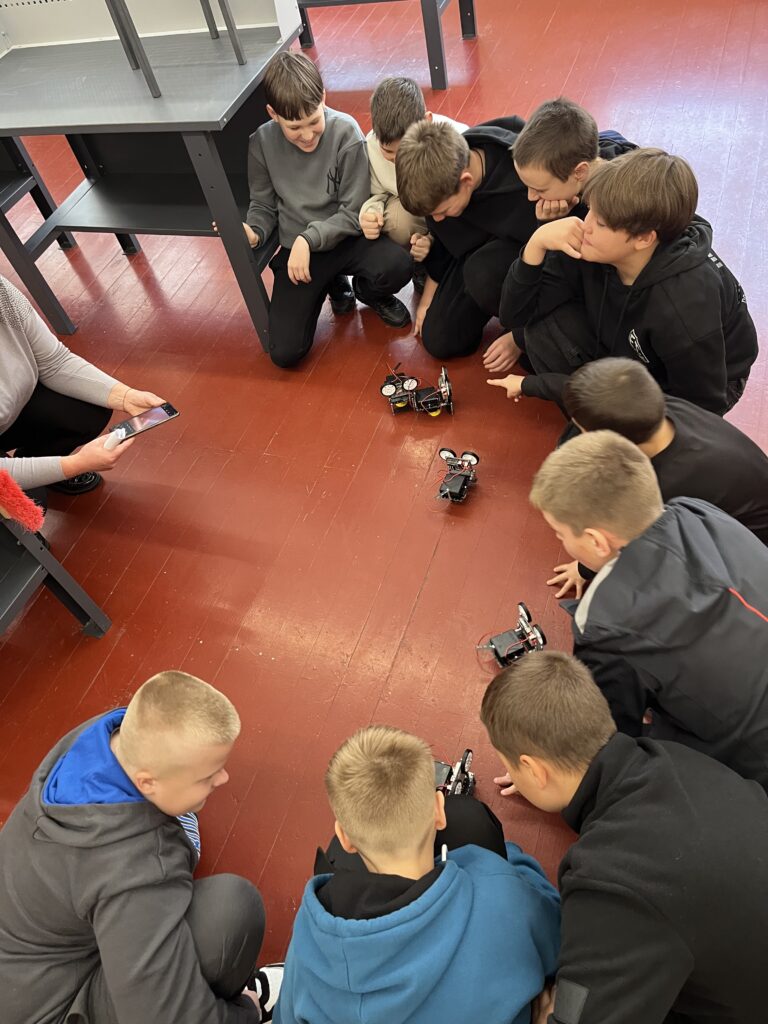
The parents are not the only ones whose dedication to Pryluky is striking. The robotics program at Lyceum #1 began with local NGO leader Viktoriia, whose love for her city is immediate and unmistakable. “I’m really just a fan of this community,” she says. “I believe young people move Ukraine forward.” Her son’s interest in robotics and her exposure to U.S. exchange programs convinced her that students in Pryluky deserved the same opportunities as students in American schools. She sought out a teacher with passion (she found one), a school ready to change (she convinced one), and equipment that could transform everything (Razom provided it). The result was a project that, in her words, “made kids want to stay in the classroom even during recess to keep building.”
Scaling Up: “Education on Wheels”
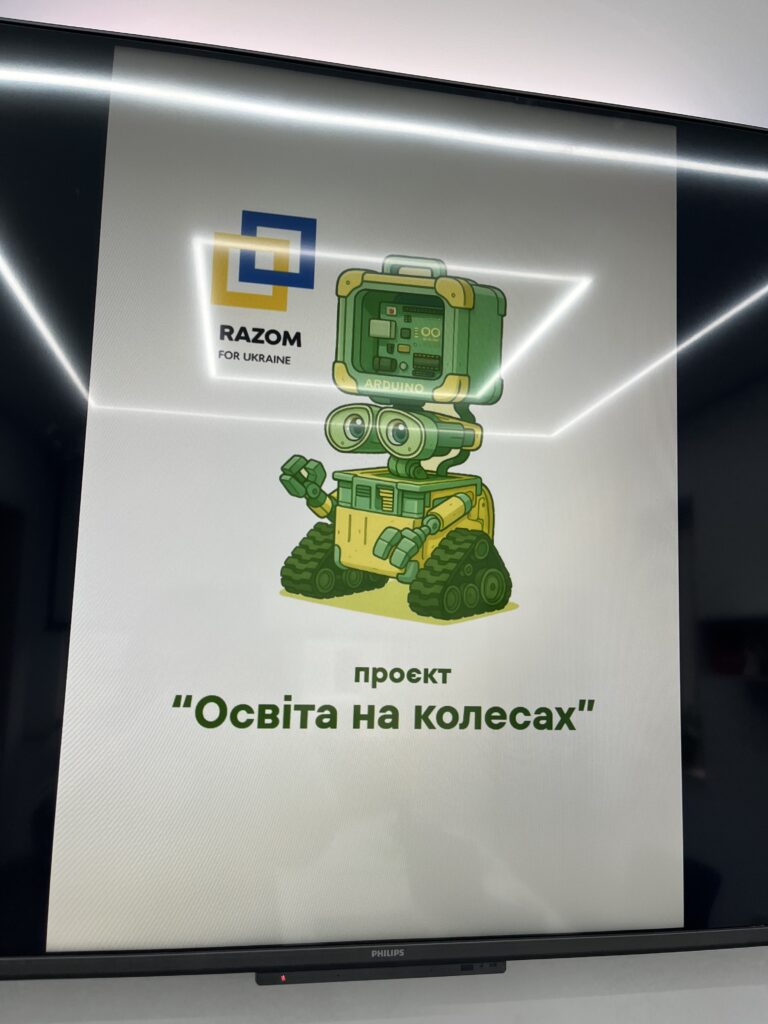
What began in Lyceum #1 has now expanded across the city through a second NGO’s program called “Освіта на колесах” (“Education on Wheels”). Coordinator Diana explains the vision: “Kids in a city like Pryluky should have the same opportunities as kids in the capital city of Kyiv,” she says simply.
Their NGO model:
trains computer science teachers citywide
shares microcontroller boards for learning coding and electronics and robotics kits across all schools
rotates equipment every two months
provides full lesson plans and methodology
ensures access even during blackouts by offering backup learning spaces
Diana’s motivation is rooted in wartime experience. “Our path through 2022 shaped who we are now,” she says. “It taught us how to adapt, how to organize, how to keep educating kids even when everything around us was falling apart.” This program didn’t just expand STEM – it built a citywide community of teachers and students learning together, sharing tools, and raising the bar for what’s possible.
What’s happening in Pryluky is more than a robotics class. It’s a blueprint for rebuilding a country from the inside out. Future drone engineers, medical roboticists, software developers, cybersecurity specialists, and startup founders start here, with a robot dog that sparks interest, a teacher who finally has the right tools, and an NGO leader unwilling to accept “impossible”. This is Razom’s model in motion: a small, catalytic investment leads to local leadership, which in turn generates exponential community impact.
Principal Rohaliova said it best: “We had the people. We had the ideas. But these kits from Razom made it possible to bring it all to life.” That is how future tech hubs begin – in the classrooms of cities some might overlook, but where hope, skill, and determination are already abundant.
We invite you to become a part of making dreams come true and helping children prepare for the future in which they apply their skills and knowledge to advancing the techonolgical innovation for a peceful, secure, and prosperous Ukraine.