In Ivano-Frankivsk Regional Hospital, the echoes of the full-scale invasion feel both far away and impossibly close. Outside, life hums along: deliveries come and go, local residents walk their dogs while chatting, people carry home warm loaves of bread and other groceries. But on the ninth floor, inside the otolaryngology wing, the consequences of Russia’s invasion are etched into the faces of the people waiting quietly in the hallway.
Most are veterans, but some are also civilians caught in the wrong place at the wrong moment. Many have lived for months and years with injuries that no one in peacetime imagines: shattered cheekbones, torn eyelids, fractured eye sockets, burn scars, and the emotional burden of carrying an altered face through the world. This fall, a team of surgeons, anesthesiologists, and nurses from the United States and Canada returned again to offer what Ukrainian patients describe most simply and most poignantly: hope.
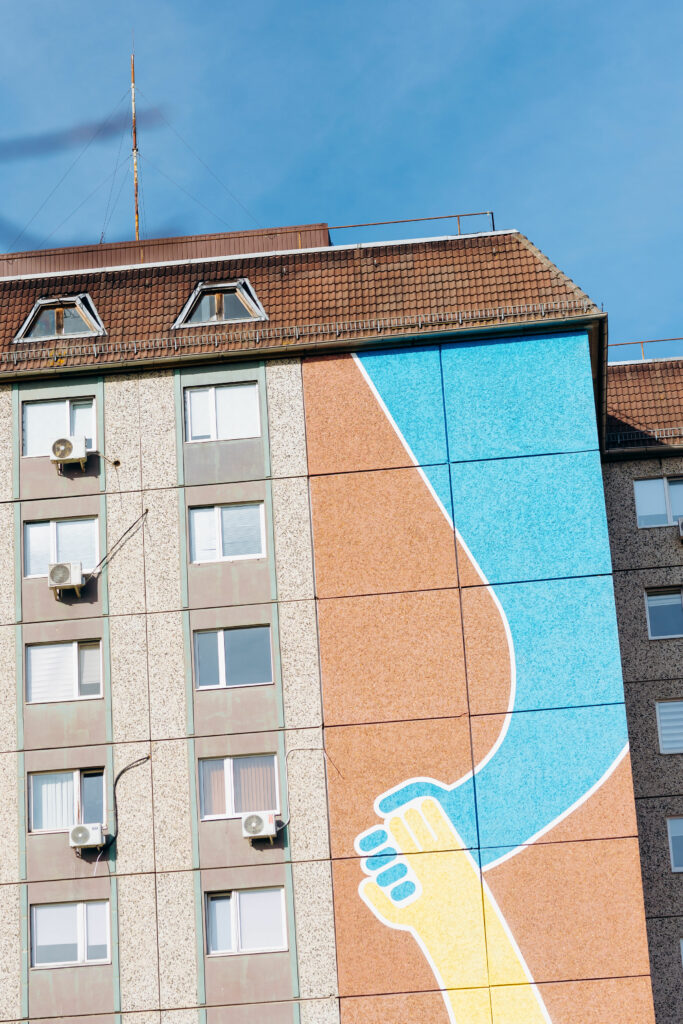
A mural with a gesture of friendship on the hospital's outer wall
This is the “Face the Future Ukraine” mission, and many hands took part in making it happen: the Face the Future Foundation, Razom for Ukraine, Still Strong , Patients of Ukraine, Ivano-Frankivsk Regional Hospital, Materialise, and Humanitarian Nova Post – as well as dozens of individual doctors, nurses, and other professionals.
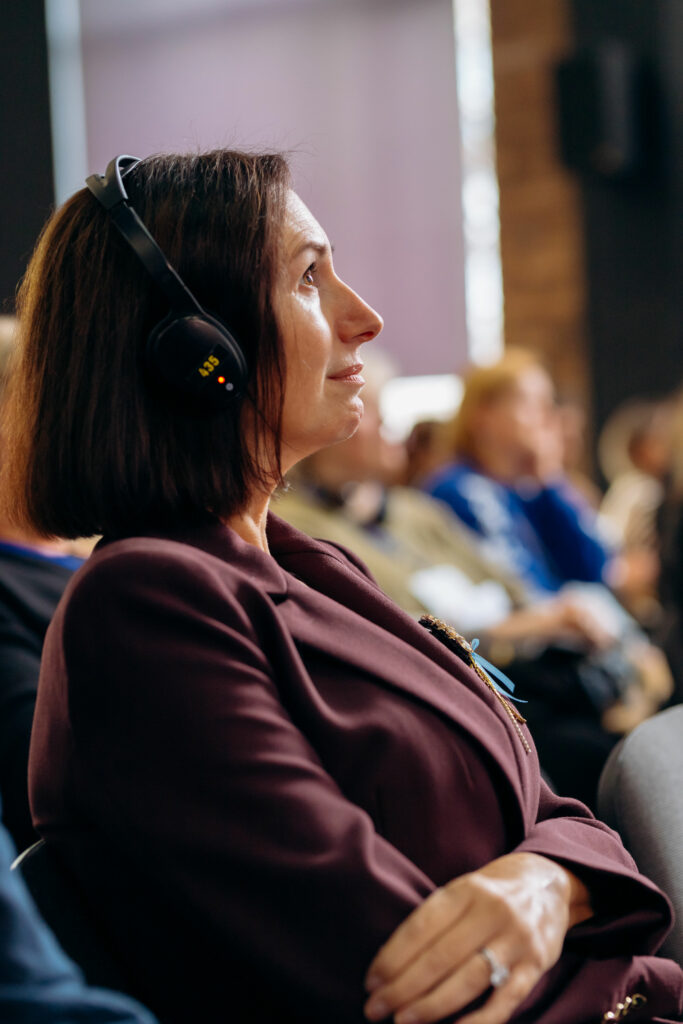
Khristie Morell listens to Ukrainian nurses present at a nurses symposium in Ivano-Frankivsk
Khristie Morell, a Canadian nurse who has been volunteering in Ukraine since the earliest days of the full-scale invasion, reflected on what she sees in every patient she meets: “Being here in Ukraine, I see that every single contact from the outside world – people really take that to heart.” She added, almost as if speaking to every Ukraine supporter around reading this: “Every single donation, every single time you think of Ukraine or spread the word, is extremely valuable.” Her words are not abstract, but rather reflect something you can only understand when you stand at the bedside of a patient waking from anesthesia while air-raid sirens sound in the distance: the world’s presence really matters to Ukrainians, especially after four years of the full-scale war.
One of the patients waiting for surgery was a Ukrainian defender named Viktor Hrytskevych. Viktor has deep wounds on his face, a missing right arm, and almost no sight in both eyes – and requested not to be photographed or have video taken of him.
He was guided into the room by his wife Natalka, who hasn’t left his side since he received his injury – walking him around the hospital and helping him with daily tasks. Somewhat reluctantly, Viktor spoke of the injuries that he carried through multiple hospitals and across regions. He recounted how he was evacuated through Pokrovsk, then Zaporizhzhia, then Dnipro, then Kyiv, and finally Odesa. Specialists restored a small amount of vision there.
He now sees light, shadow, and some shapes – “але не більше” (“but not much more”). Months later, during rehabilitation, doctors told him there was a visiting mission that might be able to help further. He didn’t hesitate. “The doctors told me there is a program offering surgery… I agreed right away.” He squeezes Natalka’s hand as he says it, sharing that his biggest dream is to see his beautiful wife’s face again.
Another patient is Andrii Dyachko, a defender who spent a year undergoing treatment in Latvia, but even going abroad was not enough. He described his injuries in raw detail: “My face was asymmetrical, the cheekbone was shattered, my eye was sunken.” Previous surgeries helped restore some symmetry, but he hoped this mission could take him further – restore function, expression, the ability to meet the eyes of loved ones without self-consciousness. For him, surgery is not cosmetic, it is truly about recognition of the self he once was and the self he hopes to be again.
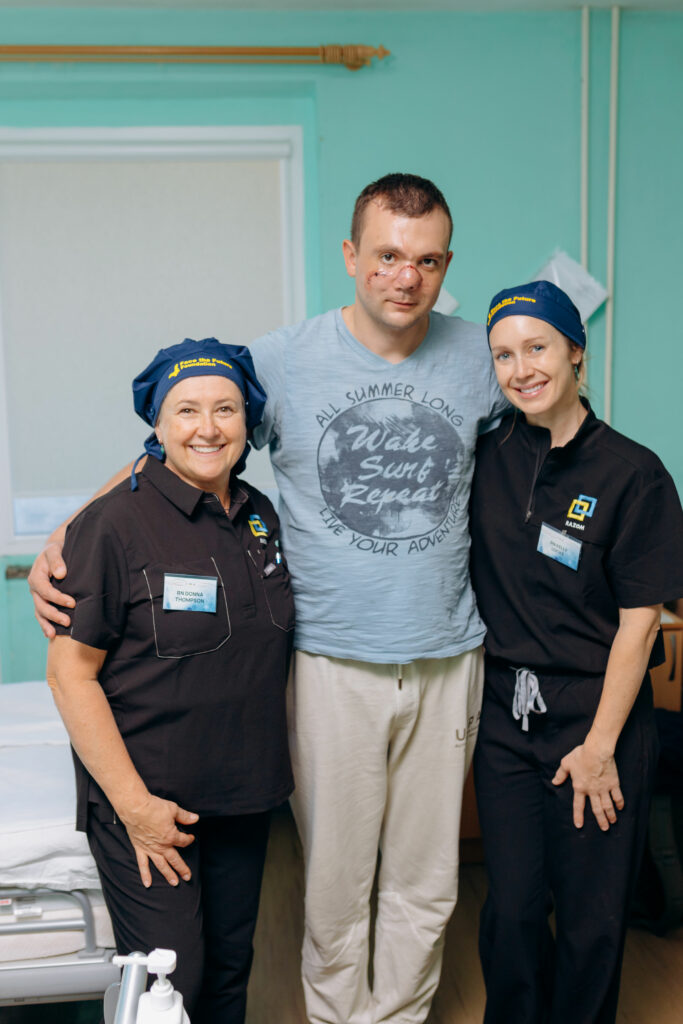
Nurses Donna Thompson and Kelly Locke with one of the mission's patients
To understand the scale of this hope, you must also hear from those who make it possible, including the Ukrainian doctors who have worked tirelessly to bring this mission to the Ivano-Frankivsk Regional Hospital. Dr. Natalia Komashko, an otolaryngologist at the regional hospital and the founder of Still Strong Initiative, is the Ukrainian lead for the mission. She recalls the earliest days of the partnership, describing how the first mission was challenging and overwhelming, but also a breakthrough: “We carried out such a large-scale mission in Ukraine for the first time… It was difficult, but it succeeded.” That success opened the door to Face the Future’s ongoing collaboration. About the international team, she says: “We saw that their values align with ours, and that we can learn a great deal from each other.” For Dr. Komashko, this mission isn’t just about surgeries – it’s about building a medical community across borders, even under war.
Drs. Raymond Cho, Natalia Komashko, Peter Adamson, with Iryna Matsiuk (Razom team)
Dr. Matthew Brace, a facial plastic and reconstructive surgeon from Ontario, has volunteered on multiple missions. His voice is calm but charged with purpose when he explains why he keeps coming back: “There’s nothing more satisfying as a doctor than helping somebody who’s in acute, dire need – when they can’t get help anywhere else.” His path to this mission began with a desire to combine trauma expertise with humanitarian care. When he first heard about Ukrainian patients waiting months or years for specialized procedures, he felt a pull he couldn’t ignore. But it wasn’t only the surgeries that kept him returning – it was the people. The Ukrainian doctors were eager to learn. The local teams who arrive early, stay late, and absorb every detail. The patients who endure what no one should.
As he put it: “To help 30 people in one week is extraordinary. But the impact doesn’t stop with them – it ripples outward to their families, their communities, their children.”
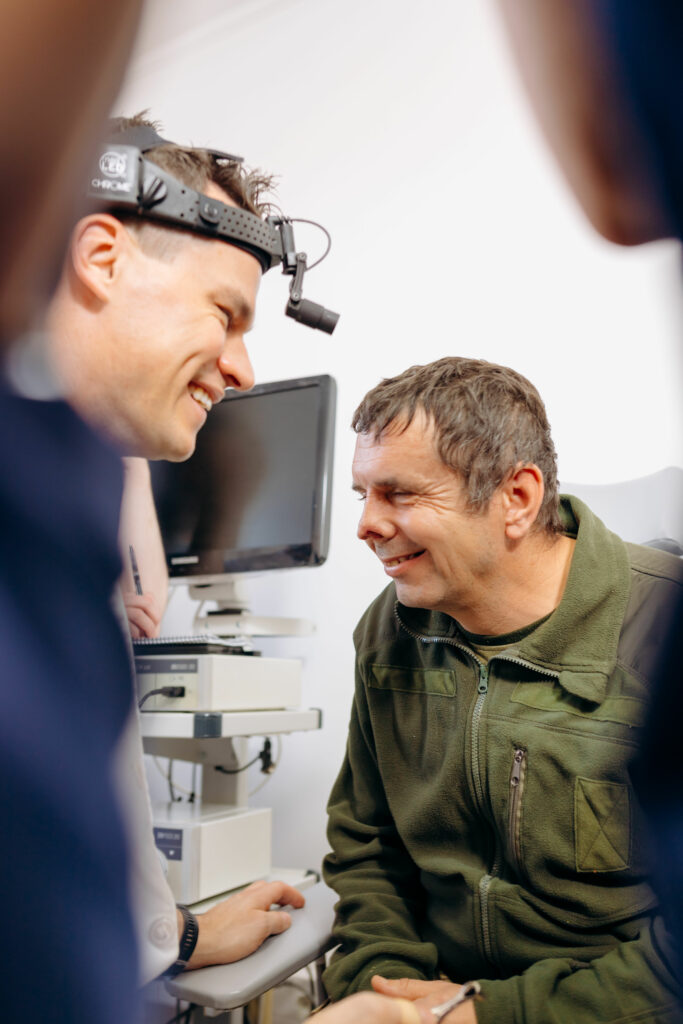
Dr. Matthew Brace during the pre-surgery consultation with one of the mission's patients
“I have four daughters and my wife, and so being away from them for ten days is probably the hardest part. They’re all very understanding. When I first told my wife about the invitation to come, she said, ‘I don’t want you to go, but I think you should.’ And my kids have been the same… we talked about it a lot as a family. I said, ‘If we were in the same situation Ukraine is in and I was injured, I would hope somebody would be brave enough to come and help.’ And my kids are totally on board with that, and they say, ‘Yeah.’”
And the patients are certainly grateful for the ones brave enough to come and help. One patient, after speaking with the mission leads, took the interviewer’s hands and said: “ [I wish] prosperity to you and your organization.” It is gratitude not for charity, but for presence and for solidarity. For the knowledge that he – and Ukraine – have not been forgotten.
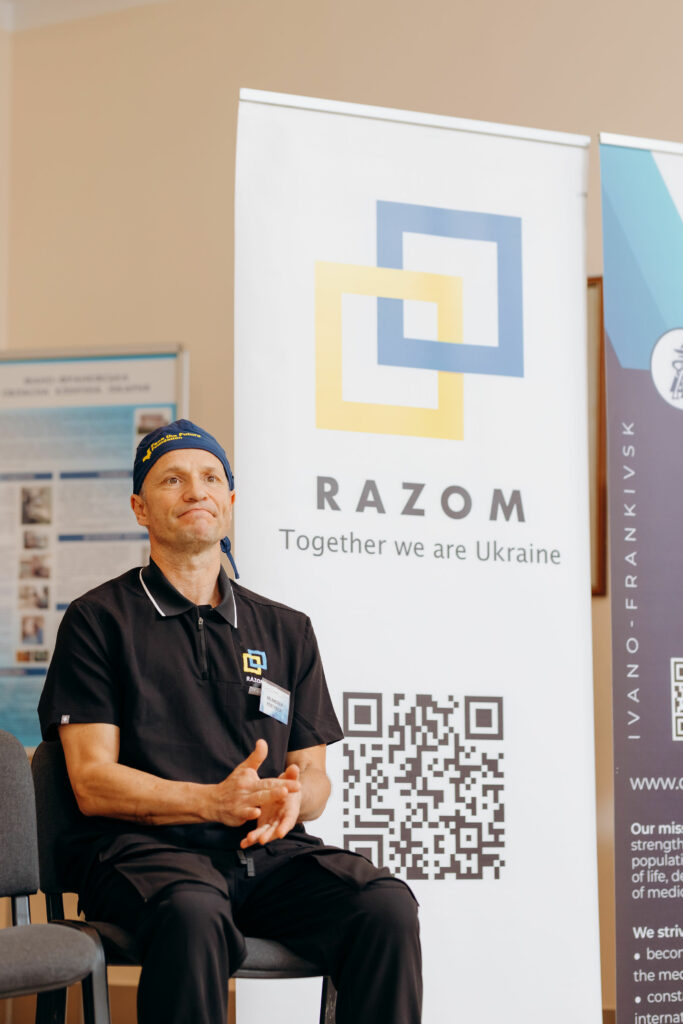
Nurse Andrew Kosteniuk duirng the mission's press conference
Nurse anesthetist Andrew Kosteniuk, a Ukrainian-Canadian member of the team, certainly understands the importance of letting Ukrainian people know that they are remembered by the global community: “It’s vital that people here don’t feel alone, don’t feel abandoned, don’t feel forgotten. We’re here to give them hope that there is a better future, a brighter future. Hope is the most important thing.” In wartime Ukraine, hope is not abstract – it emerges through the smallest gestures and moments. It looks like surgeons huddled over CT scans at 7:00 a.m, sounds like quiet Ukrainian spoken to a patient emerging from anesthesia, and feels like a promise that there are people in the world who care enough to come.
Dr. Peter Adamson, founder of Face the Future, reflects on these small moments and gestures that have a big impact through the mission’s butterfly logo: “The butterfly flaps its wings… and the impact grows.”
Dr. Adamson during the national minute of silence
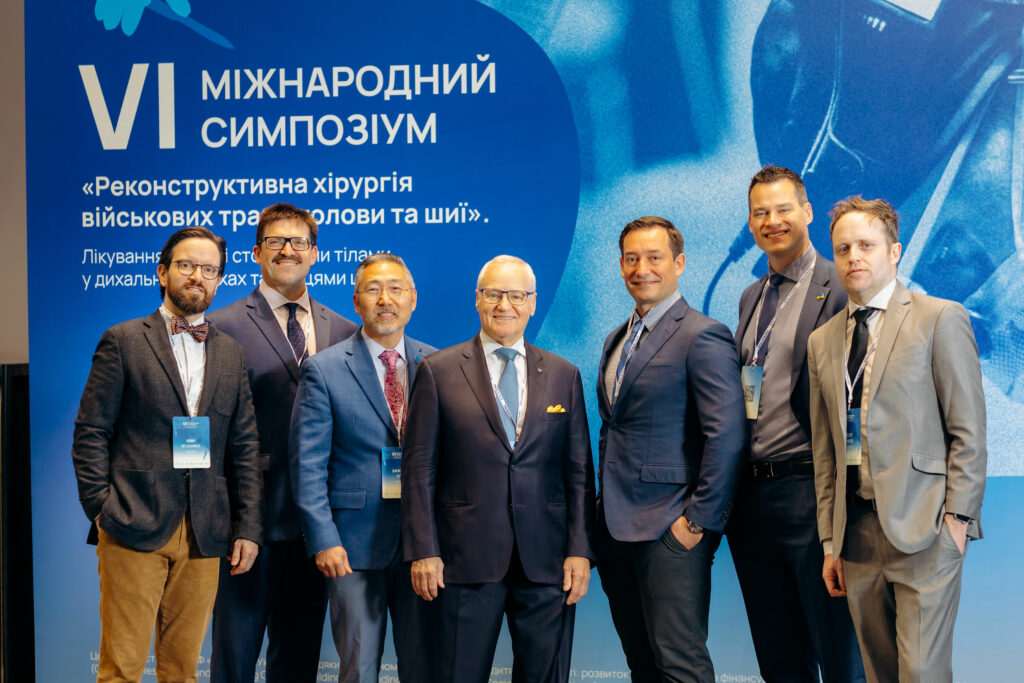
Dr. Adamson with his misison colleagues
Dr. Adamson and this year's mission surgeons
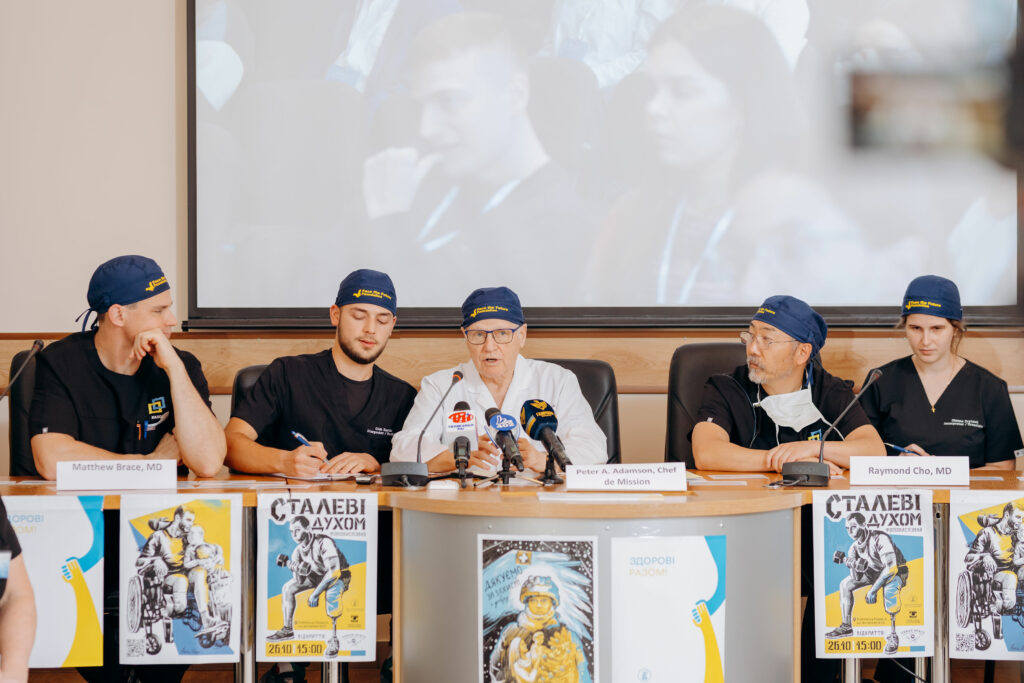
Dr. Adamson at the mission press conference
During the Face the Future Mission, this flap of wings looks like dozens of life-changing reconstructive surgeries, over 200 nurses trained in a single symposium, Ukrainian surgeons mastering techniques they had never performed before, and veterans regaining function, symmetry, dignity. In the middle of a war, small things are not small – they are everything.
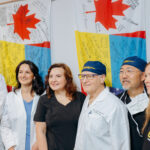
"Real life superheroes": mission's American and Canadian nurses
None of this – not one surgery, not one training, not one moment of connection – happens without a vast chain of people who believe in Ukraine’s right to heal. Razom helps coordinate logistics, secure supplies, support patient vetting, and build long-term relationships between Ukrainian medical teams and their international colleagues. The support of our donors and partners ensures that defenders with shattered faces receive world-class care and patients hear a message that matters as much as the medicine: you are not alone.
As one patient said, with a tired but grateful smile: “Я з вами заодно.” (“I am with you.”) And because of supporters like you – Razom is with them too. Together, we keep the butterfly’s wings in motion, carrying hope across a country that refuses to lose its face – and its future.