

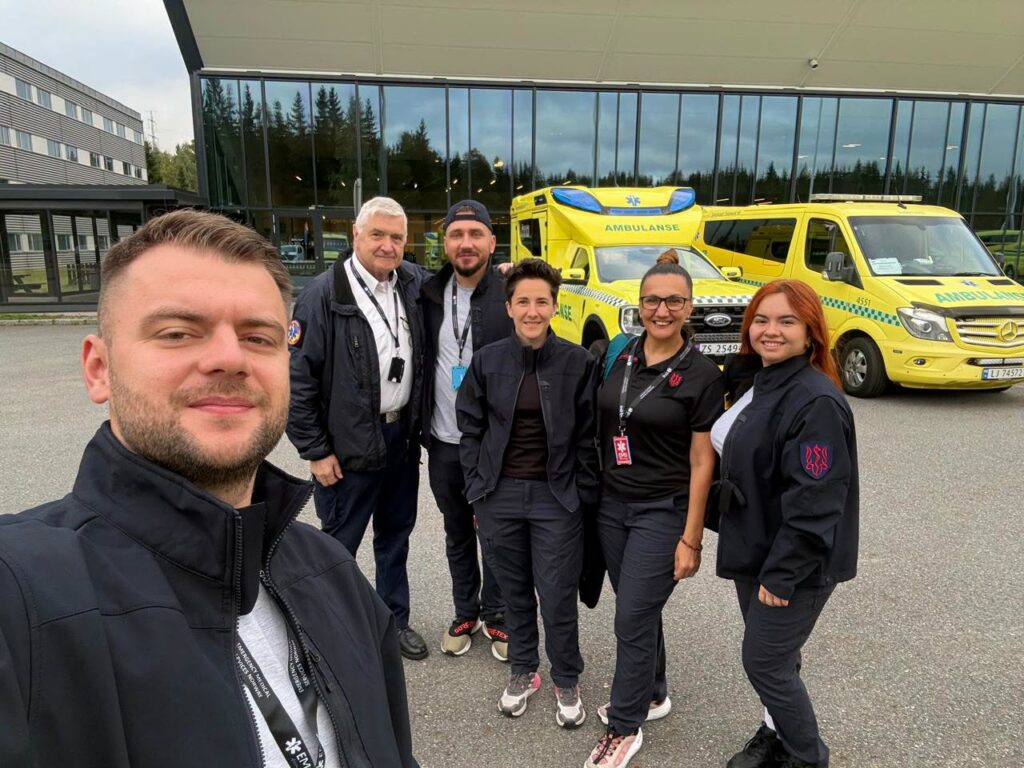
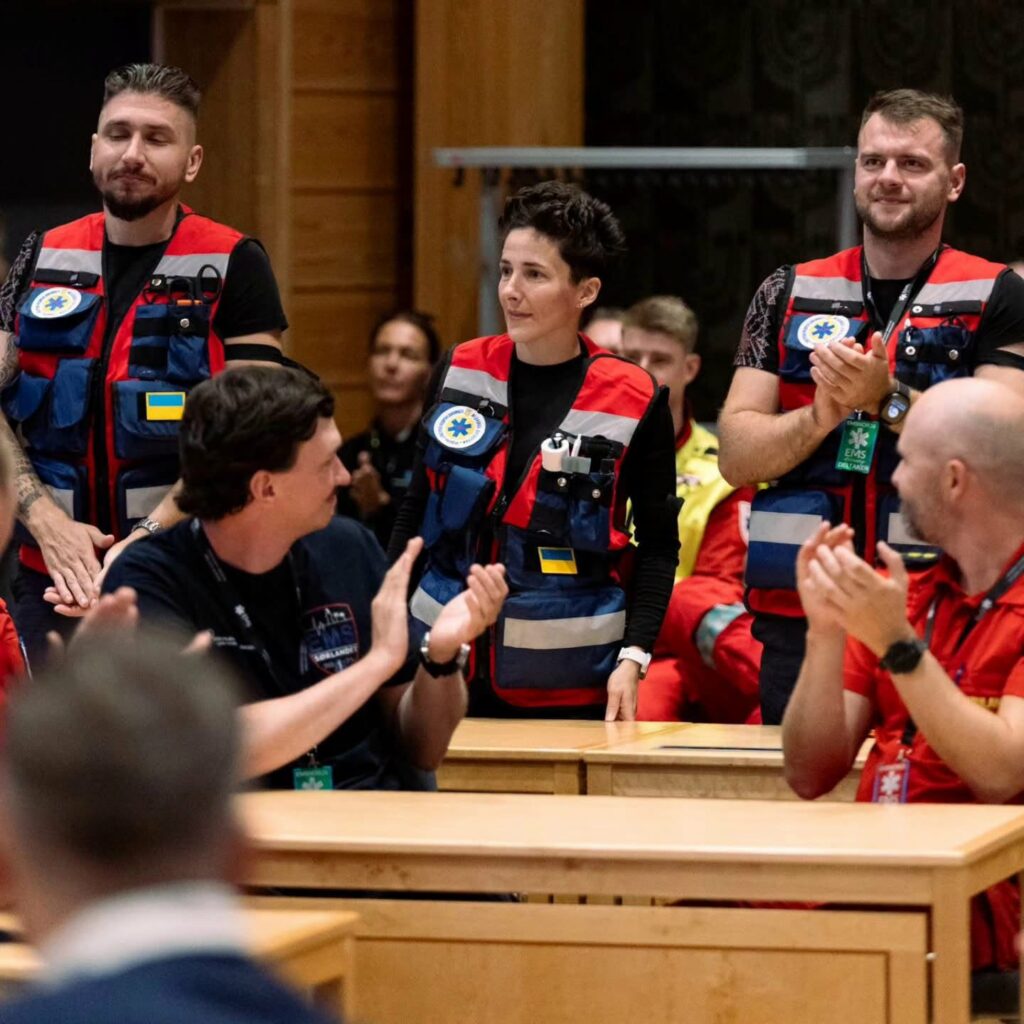
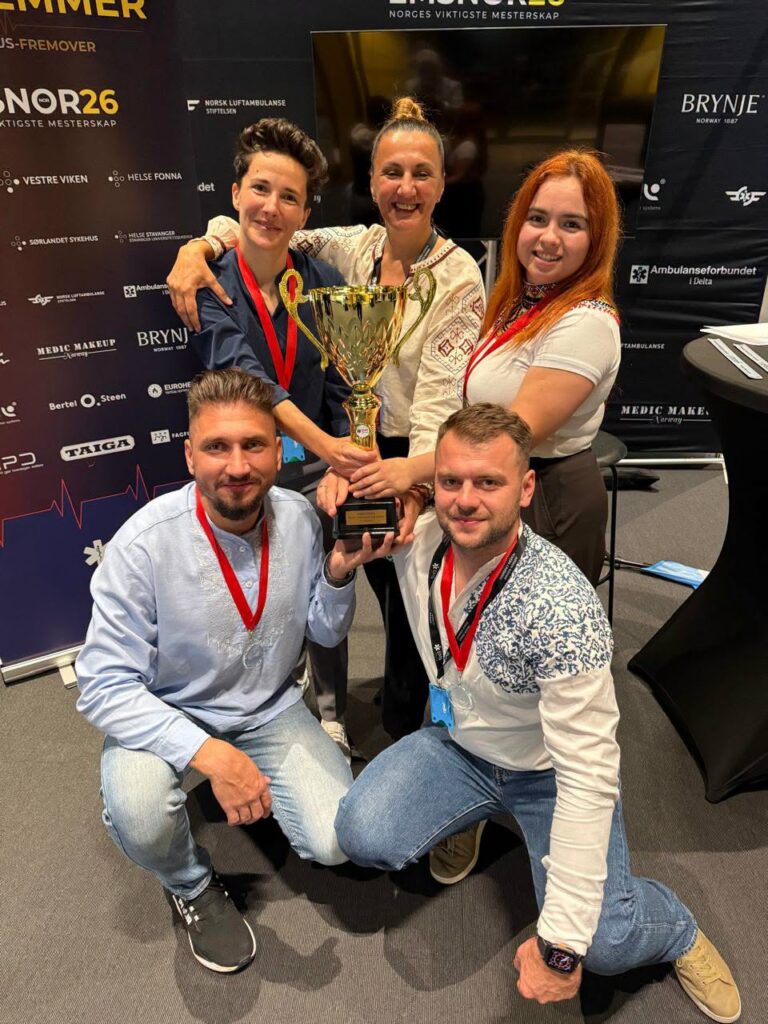
This August, in Jessheim, Norway, top international medical teams gathered for the 10th Norwegian National EMS Championship (EMSNOR26). Among them, for the first time, was Ukraine’s emergency medical services team, which became the overall champion.
Ukraine was represented by team leader Olena Volovyk, along with Roman Huk and Vadym Koshlak.
During the championship, participants completed 13 complex scenarios designed to closely replicate real emergency calls. The Ukrainian team received the title of Best International Team and earned 1,107 points — the highest score of any team in the competition. Helse Stavanger HF, the highest-scoring Norwegian team, finished with 1,065 points.
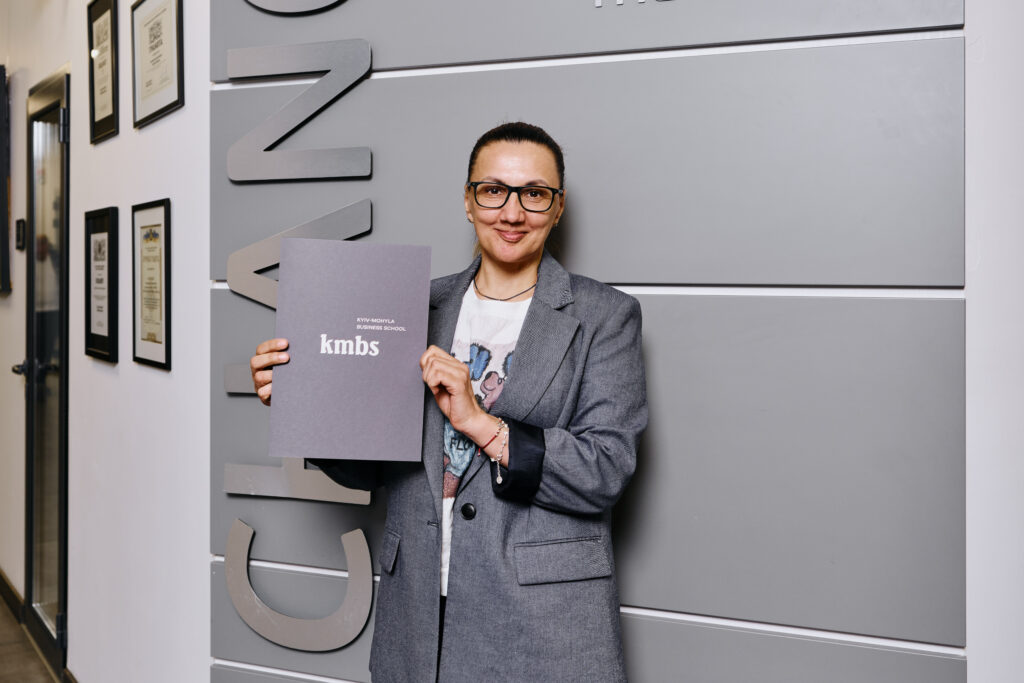
The Ukrainian team was coached by Halyna Tsymbaliuk. In Norway, she also served on an international judging panel for the first time. Halyna is a graduate of the Mini MBA, a leadership program that develops management skills among medical unit leaders in UDF. Razom implements the program in partnership with Kyiv-Mohyla Business School, the Department of Health of Ukraine’s Ministry of Defense, and the Medical Forces Command.
After Halyna returned from Norway, we spoke with her about preparing the team, the professional lessons she took away from the competition, and the role management skills played in this victory.
Halyna, you coached the Ukrainian team and, for the first time, served on an international judging panel during the championship. In your view, what was the key to the team’s victory and its first-place overall finish?
In my opinion, the key was teamwork. Before we began preparing, the team members had never worked together as a field crew under real-world conditions because they came from different cities. My main responsibility as their coach was to help four strong professionals begin working as one system.
We spent very little time reviewing theory. I knew each team member’s level of expertise: they all had strong prior training and had completed certified emergency medical care courses. We therefore focused primarily on teamwork, the distribution of roles, communication, and decision-making under pressure.
We deliberately built the team around each person’s strengths. Olena is very composed, analyzes situations well, and sees the full picture, which is why she became the team leader. Roman adapts to modern equipment extremely quickly. That proved especially important in Norway, where the team had to work with unfamiliar patient monitors, virtual simulators, and other technologies. Vadym is someone you can assign a task to and trust that it will be carried out precisely. Nargiz did much more than help the team overcome the language barrier. She is a very strong communicator and became an important part of the team’s overall coordination.
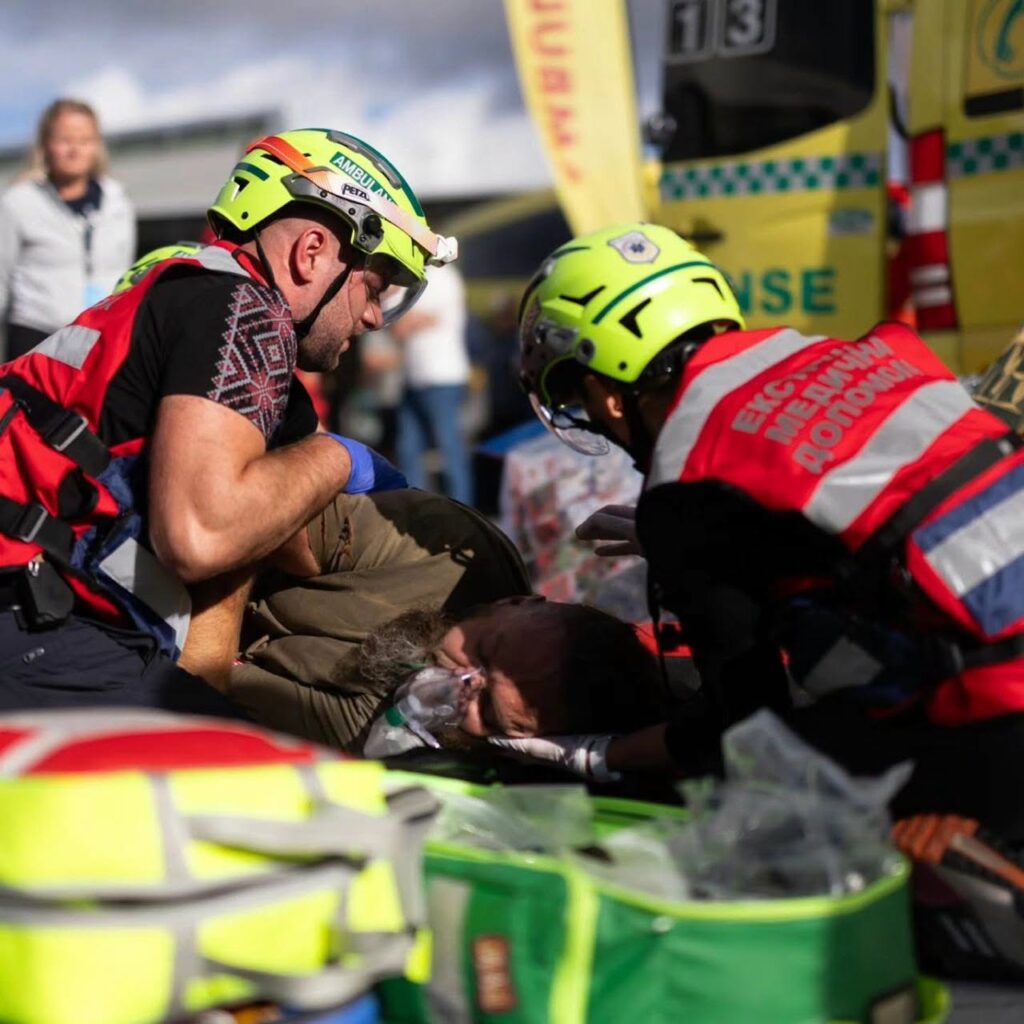
At the same time, the roles were not rigidly assigned. They could change depending on the task. We were not trying to make everyone equally strong in every area. Instead, we identified what each person did best and looked for ways to combine those capabilities so they reinforced one another.
This was essential to me because I have extensive experience with national championships. I have repeatedly seen teams composed of very strong professionals fail to achieve the expected result when working together. Conversely, I have seen teams excel even without obvious individual “stars” because they had clearly defined roles, mutual trust, strong communication, and a shared understanding of who needed to take responsibility at a particular moment.
After the championship, the team joked that I was a tough coach and that the training sessions had been more difficult than the championship itself. I choose to believe that was a compliment. (Laughs.)
Most importantly, our preparation strategy worked. For me, it confirmed once again that a strong team is not simply a collection of the strongest individuals. It is a team in which each person’s strengths are brought together effectively in pursuit of a shared result.
Which practices, approaches, or technological solutions that you saw in Norway should be adapted for Ukraine’s emergency medical services system?
What impressed me most was not any individual technology but the systematic organization of emergency medical services. The ambulances were equipped to a very high standard, the working environment was standardized and ergonomically designed, and there was a deeply embedded culture of safety.
I would especially highlight the way EMS professionals are treated as a critical resource within the system. Ambulance stations are organized so that after a difficult call, team members have an opportunity to recover both physically and psychologically. In a system where people work under intense stress, this is not simply a matter of comfort. It affects professional resilience, worker safety, and, ultimately, the quality of care patients receive.
Another area Ukraine should clearly strengthen is high-fidelity simulation training. The level of immersion at the championship was extraordinary. Professional makeup artists, actors, specially prepared locations – including a restricted-access facility and a construction site with a tower crane – and audiovisual effects created a complex and highly realistic environment. At a certain point, participants stopped experiencing it as a training scenario and began responding almost as if it were a real emergency.
This kind of simulation evaluates much more than whether a team knows the correct clinical algorithm. It shows how the team makes decisions under cognitive and emotional pressure, whether it maintains situational awareness and effective communication, and whether it can set the right priorities. I am convinced that this is a critical element in the effective preparation of EMS professionals in Ukraine.
What does this victory mean for Ukraine’s emergency medical services, and what does it demonstrate to the international professional community about the capabilities of Ukrainian specialists?
For me, this victory is first and foremost independent confirmation that the professional training of Ukraine’s emergency medical services is moving in the right direction. Our team worked in an unfamiliar professional environment, used equipment it had not encountered before, communicated across multiple languages, and was evaluated by independent judges. Despite all of that, it earned the highest overall score in the championship.
Serving on the international judging panel was also a particularly valuable experience for me. For the past three years, I have served as the head judge of Ukraine’s National EMS Team Championship, so I know the entire process from the inside: from developing scenarios and evaluation criteria to selecting and preparing the panel of judges. That made it especially interesting to see how the process is organized in Norway.
Their approach differs somewhat from ours. Judges do not participate in developing the scenarios. At each location, they essentially act as independent evaluators, while a separate team prepares and conducts the scenario itself. A great deal of attention is also devoted to preparing simulated patients. If a scenario involves a pregnant patient, she is portrayed by a pregnant woman. If a traumatic amputation is being simulated, the organizers involve a person who has actually undergone an amputation. Combined with professional makeup, trained actors, and carefully prepared environments, this creates an exceptionally high level of realism.
At the same time, I was pleased to see the other side of this professional exchange. The Norwegian specialists were also interested in Ukraine’s experience. While working at the different locations, we discussed the scenarios, evaluation criteria, and the teams’ actions in detail. Our colleagues asked how we recreate and evaluate similar situations during training exercises and championships in Ukraine, and they genuinely listened to our perspective. I even joked that we judge teams a little more strictly in Ukraine.
One of my main conclusions after this trip is very simple: we already have valuable expertise to exchange. There are aspects of training organization that I would gladly adapt from Norway. At the same time, we saw that Ukrainian approaches and our practical experience are also of real interest to the international professional community.
We would therefore be very glad to see this exchange continue and to welcome our Norwegian colleagues to the next National EMS Team Championship in Ukraine—both as a participating team and as members of the international judging panel.
Did the knowledge and management tools you gained through the Mini MBA — a leadership development program for medical unit leaders in UDF — help you prepare the team and organize its work? If so, which tools were most useful?
Yes. I recognized their value especially clearly after the championship, when I began analyzing why our preparation strategy had worked.
I had a group of strong professionals with different areas of expertise who had never worked together before. My task was not to make them all the same. It was to recognize each person’s strengths, distribute roles effectively, build trust, and unite them around a common goal.
This is where the management approaches we studied during the Mini MBA proved genuinely useful: situational leadership, team building, delegation, the distribution of roles and responsibilities, priority setting, and team communication.
It was especially important for me to understand that leadership does not mean one person must be the best at everything or control every action. Depending on the situation, a leader must create space for the team member whose expertise is strongest at that particular moment. That is why some of our roles could change from one scenario to another.
Perhaps the main management lesson connecting my Mini MBA experience with this championship is that a leader’s role is not to be the strongest person in every area. It is to recognize people’s strengths, bring them together effectively, and create the conditions in which the team performs better together than any individual could perform alone.
That is why I devoted much more attention during our preparation to how the team worked together than to what its members already knew. The championship results showed that this approach worked.
The Ukrainian team’s victory was made possible by the participants’ professionalism, clinical experience, intensive preparation, and ability to adapt quickly. At the same time, their story demonstrates the importance of management skills in medicine.
The Mini MBA is designed to help medical unit leaders strengthen more than their individual expertise. It equips them to lead their teams more effectively — to distribute responsibility, build trust, make decisions under pressure, and implement meaningful changes within their units.
For Razom, stories like this demonstrate the long-term impact of supporting leadership development. An investment in the education of one medical leader does not end at graduation. The knowledge gained becomes part of daily practice, influences entire teams, and helps strengthen Ukraine’s medical system as a whole.
Halyna Tsymbaliuk’s experience and the Ukrainian team’s victory at EMSNOR26 offer a concrete example of that impact: the management tools she gained through the program were put into practice and helped unite professionals with different strengths around a shared goal.