


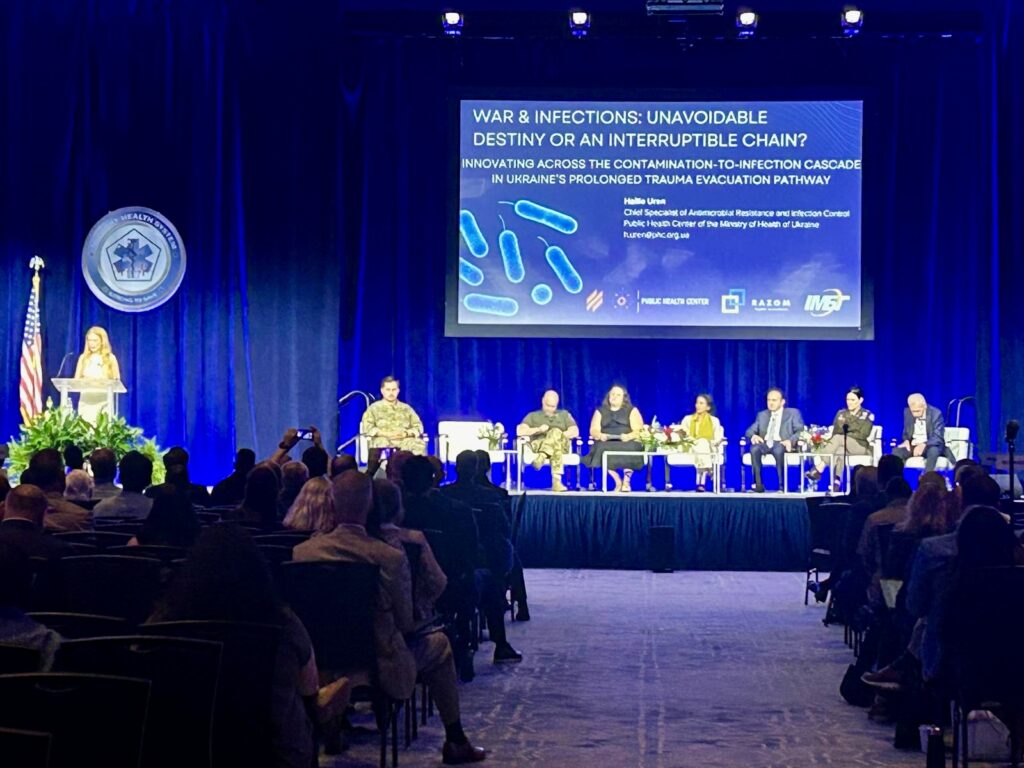
The Infection Prevention project, implemented by the Public Health Center of the Ministry of Health of Ukraine and the Institute of Molecular Biology and Genetics of the National Academy of Sciences of Ukraine with the support of Razom for Ukraine, was presented in the United States for the first time since its official launch in Ukraine — at the Military Health System Research Symposium (MHSRS) 2026.
MHSRS is one of the key conferences in the field of military medicine, bringing together thousands of military medical professionals, researchers, clinicians, and representatives of healthcare systems.
The project was presented by Hailie Uren, Project Lead and Principal Investigator from Public Health Center. Before an international audience, she presented new interim findings from the study for the first time.
To date, 293 people have participated in the study. The results are still preliminary and do not yet allow for definitive statistical conclusions, but the team is already beginning to identify resistant bacteria at the early stages of casualty evacuation.
“It was especially important for me to present this project at the Military Health System Research Symposium to an audience of approximately 5,000 people. Together with my team, Ukrainian military and civilian clinicians, and international partners, we are working on a new approach to caring for war-wounded patients. The goal of this work is not only to save lives and preserve the limbs of wounded people in Ukraine today, but also to create solutions that can change the approach to battlefield medicine in future wars.”
— Hailie Uren, Project Lead and Principal Investigator
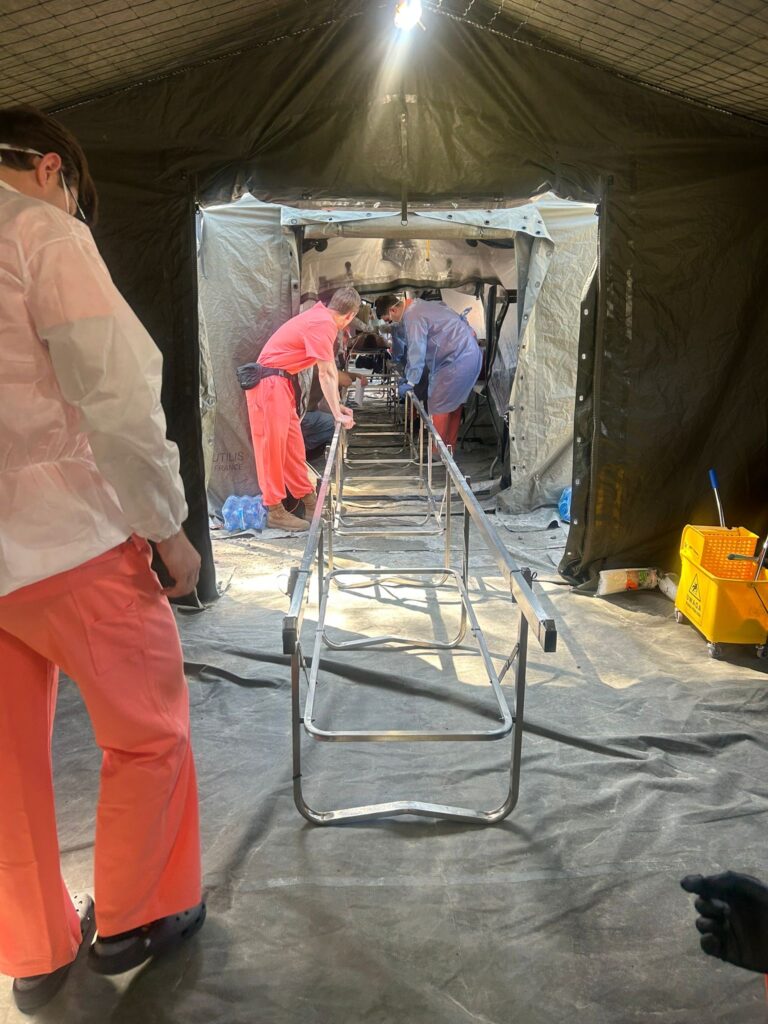
The project examines how multidrug-resistant organisms move with war-wounded patients through the medical evacuation system — from the earliest stages of care through hospitalization. The research brings together civilian public health, surveillance, microbiology, infection prevention, and health-system improvement.
A war-wounded patient passes through several stages of medical evacuation — from the casualty collection point and prehospital care to field surgery and hospital care. The longer this journey, the more opportunities there are for multidrug-resistant bacteria to be acquired and transmitted.
That is why researchers are studying the entire evacuation pathway to determine where the risk emerges and where intervention can occur as early as possible. Based on the data collected, standardized approaches to early decontamination pre-hospital are being developed to help reduce the risk of severe infections, the need for broad-spectrum antibiotics, and the spread of resistant bacteria.
The presentation showed significant interest among conference participants. Several conference participants reached out to learn more about the project, discuss opportunities for collaboration, and explore ways to become involved in the work.
“You presented one of the most impressive and important presentations I heard during the four days of the conference. Keep up the great work that you and your colleagues are doing!”
— one of the conference participants
(For security reasons, we cannot publicly disclose the names of all participants.)

The Ukrainian experience in this field is important far beyond Ukraine. Antimicrobial resistance is a shared risk across health systems, and it is managed best where it starts. Ukraine is one of very few settings where the full evacuation pathway can be studied end to end — which is why the standardized early-decontamination approaches emerging from this work matter to military and civilian medicine well beyond Ukraine.
That is why Razom supports projects that help not only treat the consequences of war, but also prevent them.
This project works because it’s led by Ukrainian institutions, not layered on top of them. The Public Health Center and the Institute of Molecular Biology and Genetics are doing the core scientific work. Razom’s role is to support that work and help it reach audiences that can use it, including at MHSRS.
— Dan Solchanyk, Director of Health, Razom for Ukraine
Infection Prevention provides an opportunity to study these risks directly in wartime conditions and to develop and trial innovative approaches that may be useful for military medicine not only in Ukraine, but also during future large-scale wars.